
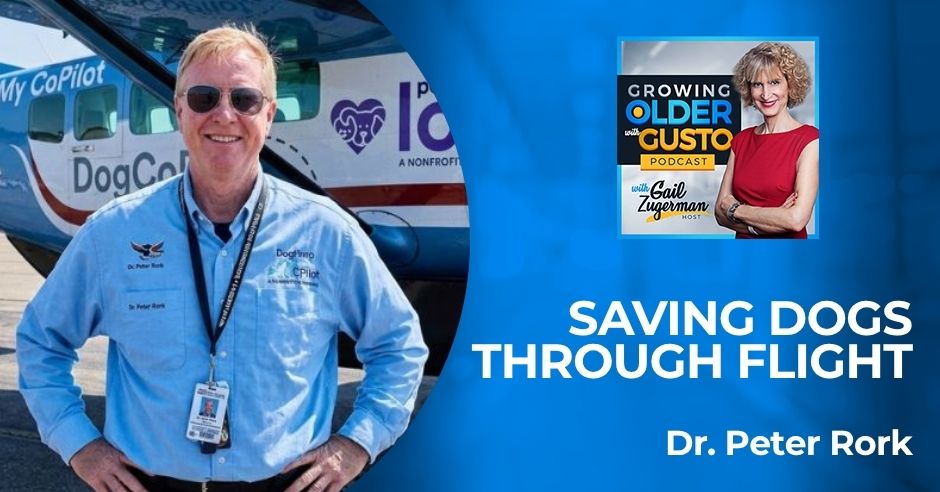
Gail Zugerman talked with Dr. Peter Rork, a retired orthopedic surgeon who took his passions of saving animals and flying to create Dog Is My CoPilot in 2012, a not-for-profit dedicated to saving dogs and cats from overcrowded shelters to their forever homes across the country. He explains how he has grown the organization from flying 20 animals at a time in a small plane to operating three Caravan aircraft that now transport60-150 animals monthly. Peter also discusses his relationship with Petco Love Foundation and its three key principles of Dog Is My CoPilot that prioritize animals’ wellbeing.
—
Watch the Episode here
Listen to the Podcast here
Saving Dogs Through Flight
A Doctor Turns To Saving Dogs & Cats
Welcome to the show. The show is a podcast dedicated to people who are showing the way of growing older in a positive and productive way. We have a return guest who keeps being a great example of growing older with Gusto. Peter Rork is a retired orthopedic surgeon who turned his passion for dogs, animals, and cats and flying into a wonderful enterprise that keeps on expanding. He is a founder and chief pilot of Dog Is My CoPilot, Inc., an organization that transports both cats and dogs who are living in overcrowded shelters to their welcoming families. Welcome to the show again, Peter. It’s so good to see you.
Thank you, Gail, for having me back. It has been a minute.
The Origin Story Of Dog Is My Copilot
A fast minute. For those audiences who are new to the podcast, can you tell them a bit about how you got started with Dog is My Copilot? By the way, it is a great name.
Thanks. It is a play on words from the movie from the ‘40s. God is My Copilot. I started this in 2012. I just left my orthopedic practice. I was just getting a little burned out by that and the direction that medicine was changing, so it was no longer that much fun for me anymore. I had a small aircraft, and I had a rescue dog, and I thought, “This is something I can do to get back.” I started flying with the small aircraft, and I would fly one or two animals at a time, really not making much of a dent.
I was introduced to a woman in the central Valley of California who ran a nonprofit transporting dogs, and they transported them by ground, walking through their shelters, where they had a 94% euthanasia rate. She was desperate to save animals, and she would put twenty or so in a van and drive them up to Portland, Seattle, Spokane, Denver, I would say, and these were like 12, 14, 16-hour trips, and once the dogs are in the crate, they stay in the crate till they get to their destination.
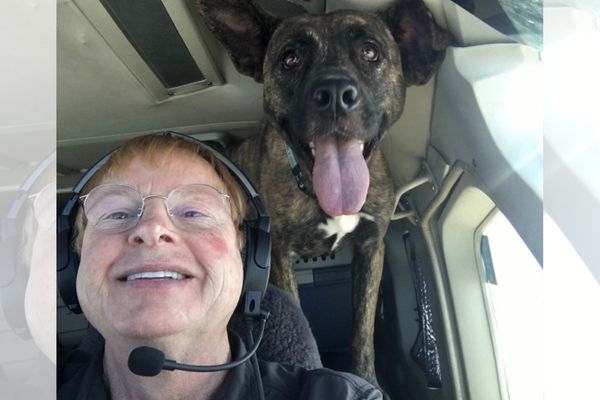
I said, “I can knock these flights off in 4 or 5 hours.” I started flying exclusively for her, but the receiving groups would also receive dogs from other locations. They asked me if I would not fly to the other locations as well. Pretty soon, I outstripped the size of my aircraft. I scaled up and bought a caravan, which is like the perfect aircraft for this mission.
How much about the caravan? I am curious, what does it look like?
It is still a single-engine airplane, but it has a turbine, which is measurably a stronger engine and about three times the size of the aircraft that I was flying. I went from flying twenty dogs at a time, and the very first flight I did with that aircraft, I had 251. We were very conscious about numbers at that time, the number of animals, but it really was not serving the needs necessarily of the sending and the receiving groups. We stepped away from that completely.
Now we let the centers and receivers decide who needs to be transported and where. We now fly anywhere between 60 and 150 animals at a time, depending on the size of the crates, because the crates will fill up the cabin of the aircraft. Long before we got overweight with the airplane, I went from flying about a thousand animals a year. We are now flying about a thousand a month. We scaled up about ten years ago to the first caravan. I spoke with you a couple of years after that. We could not really meet the need, so I went out and bought a second caravan.
That really stretched our budget. We flew that for about a year, and then it was upended in a tornado down in Texas. It was not completely destroyed. It was sent off to the repair shop, and actually, two years later was its maiden flight after the repair. Since we had already committed to flying for all these animals with two aircraft, I went out and bought a third, and that really emptied all of our coffers. That was a tough time for us financially, but it was meeting the needs of the community. It was always my plan to scale up and divide the country into thirds.
That was my next question because I was wondering, I know we spoke a few minutes ago that you were primarily in the Southwestern part of the country. Talk to us about how it has expanded geographically.
Initially, we would fly out of New Mexico, West Texas, and Southern California and fly them up to Poulsen, Seattle, Spokane, and all the little airports in between. One thing that we learned when we scaled up, instead of me flying twenty dogs from the origin to the destination, going home and having a beer. If we were flying 100 or 150 animals at a time, no one group could assimilate 150 animals. It would take 4 or 5 or sometimes even more groups to take all these animals. That now started with 2, 3, or 4 stops along the way, or 4 or 5 receiving groups at the destination.
It takes a lot of coordination. We actually have a person dedicated specifically to that, called our rescue flight coordinators, who will stay with the flight starting the day before, making sure everybody shows up on time, getting them to the airport, and having the receiving groups at the airport on time. We do not have to spend more than 30 minutes or so on the ground. It was always my idea to scale up. Now we had the West Coast covered, bought the second aircraft, and put it in the Dallas area. We had the central part of the United States covered.
We are flying from Dallas, Texas, all over Texas, up to Wisconsin and Minnesota, Illinois, and Iowa. All the states there. It was our goal then to get a third aircraft and base it on the East Coast. Basically, we are flying from north to south. The key to our success is that we do not do a one-and-done flight. We fly the same flights and schedules over and over again. The sending groups know we’re flying out of Lone today, and they’re going to be back in three weeks.
Saving Dogs: We do not do a one-and-done flight. We fly the same flights and schedules over and over again.
When we fly the same routes, and we drop off the dogs, the next time we’re in that city, the dogs that we had dropped off in those crates, the receiving group will wash the crates down, disassemble them, and then we load them back onto the airport. The crates are doing this merry-go-round on our flights all the time. We never have to go through the purchase of the new crates. Part of that is that these crates can get old and broken down. We will have, on occasion, a dog that will break out on a flight. The plane is so packed full of these crates. It is a huge Tetris game.
I am curious. Tell us a little bit about. I have two things that came to mind. How do you distinguish between the facilities that you decide are the ones that you want to work with? Obviously, you only have so many days in the year and so many planes. How does somebody stand out in your estimation for you to consider working with them?
What we ask is that the sending group fill the aircraft. That is not a problem. Finding the dogs to transport is not a problem because the municipal groups in the south are completely overrun. They only have four options for them. They can adopt them out, they can foster them out, they can transport them out, or they can euthanize them. We’re working with groups that have euthanasia rates up to 40%.
The thing that makes me feel so good about what we do is that we’ve dropped their euthanasia rates by half by transporting these animals out. The transport is not getting the animals like 100, 200, or 300 miles away. They can do that by ground. What we do, we’ll fly them a thousand optical miles away. These are groups that are well funded, the receiving groups. They have the capacity to take these animals in and foster them until they can be adopted out.
Typically, it takes about three weeks for them to offload the animals that we bring in. Three weeks later, we’re bringing in another load. Some of these groups had worked with the receiving groups for a long time on ground transport. What we did was just substitute by air. Instead of spending 24 hours in a van, which many of them would do.
I would imagine they might pick up diseases too while traveling on the ground traveling.
It is tough for everybody because even for the drivers, there is a huge sense of urgency, because they do not stop every three hours and let these dogs out to pee. Once they’re in the crate, they’re in the crate until they get to their destination. It is really tough on everybody. We really made it a whole lot easier. Economically, we’ve been able to do so through economies of scale to make it reasonable to transport by air.
When I was with a small aircraft, it would cost us about $75 per animal per transport, which is still reasonable when you consider the expenses involved with getting the animals, getting them vetted, getting them spayed and neutered, bringing their immunizations up to date, housing them, paying the rent for the housing, etc. We’ve been able to actually lower that through economies of scale.
We’ve worked really hard at working with fine point pencils, finally sharpened pencils to keep those expenses low, because we do not want people donating to the nonprofit thinking that we’re wasting their money. Really, our administrative costs are very small and narrow. When you look at the United Way and other groups, whose administrative costs can exceed 50% of all the money that they’re getting in. You look at the salaries that their CEO is making. Let me tell you about my salary. It is buckless. I do not get anything out of this.
What you’re doing, it is amazing.
Now, I do have a good team, and they do like to make a living, but honestly, it is embarrassing what I pay them. They do it because they want to do it. Ours is not a job. Ours is a want-to job, and everybody steps up. They know that I take good care of the employees. Have health insurance. Have a small 401(k) for them and that type of thing, but their days are long. Our pilots are in the cockpit from 5:00 AM until 5:00 PM. Our rescue flight coordinators are up. Before that, making sure on the phone that everything is going well, texting with the pilot throughout the day to make sure that everything is staying on schedule.
The next day started all over again. We have aircraft in the air virtually every day of the week. We’re very busy, a lot of moving parts. We have a terrific executive director, Taylor Pollard, who does a great job running this whole thing. We have a pilot coordinator, Frank Bereska, who does a great job running this. When I was doing it by myself, and then we expanded to the first caravan, I could not do all the flights myself. We were all volunteers at that point.
Now we’re three aircraft. We cannot fill up with volunteers. I have three full-time pilots. I have two going on three rescue board coordinators. We’ve had the executive director. Still, this is less than twenty percent of our budget. We run it very weakly. That includes whatever small amount of marketing we have. If your donors send a donation, I’ll send them a license plate frame, this is stock as of my co-pilot on it, and a little magnet for their car so they can be on Team DIMC.
Difference Between Transporting Dogs And Cats
I am curious, how is transporting different between dogs and cats? You mentioned you also transport cats. Is that true?
Yes, we do. Here is the secret. In 2025, we actually transported more cats than dogs. I am not changing the name. The cat is my copilot. Although Marcie, my partner, is a cat lover. She loves our dogs. She’s rocking them back. Interestingly, the euthanasia rate for cats is much higher than it is for dogs. If the receiving group will take them, we’ll take them and roof them, a lot more cats, because the size of the animal is very small and those cat breeds are very small. For the weight and balance of the aircraft, it works out really well because we could put them way aft in the aircraft, and keep the heavier dogs up front, which works out well for the airplane.
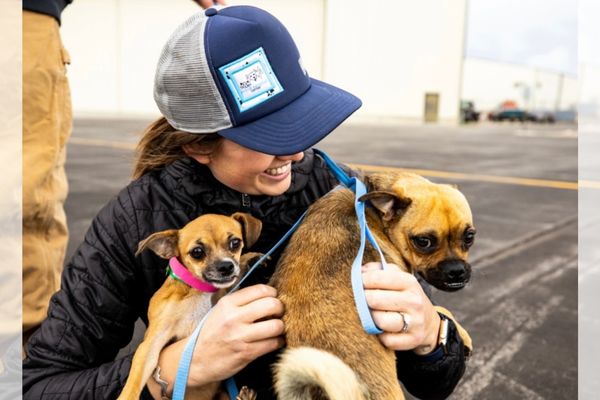
Saving Dogs: The euthanasia rate for cats is much higher than it is for dogs.
Do you have to balance the weight according to the weight of the dogs? How does that work?
It is part of the balancing act because if we’re making 3 or 4 stops, we have to make sure that we load the dogs in the reverse order that they’re getting out, so we do not have to keep unloading and then reloading the whole aircraft. We have the crates color-coded with a tag for their destination. It is easy for the pilot when we jump into the back of the aircraft at our first stop, say, “All the yellow tags get off here.” We know that there were fourteen crates getting off at this location. We count the crates. The person who is the ground coordinator for that stop will then determine which receiving groups get what animals. This is all done in advance by a rescue flight coordinator. They have a very busy job juggling all these oils.
This is a wild oil machine you’ve created here.
It is huge. Believe me, they benefit from every mistake that I’ve made in the past. We’ve been the right dog at the wrong airport, wrong dog at the right airport. Our receiving groups are terrific. If the dog is there and they have a health certificate, they were not supposed to receive it, but they’ll accept them. The one point I want to make is that when we get to these airports, everybody wants to talk to the pilot or you guys or their heroes.
The heroes are the people who are working in those municipal shelters down in the South who have to walk in there every day with an extremely limited budget and look at these animals so they know that a certain percentage are not going to be, they’re not going to get out of there. They go in every single day and look at that, cleaning out the stalls, walking the dogs, socializing them, changing the water. It is an amazing job that they do.
My hat is off to them. If you go through a shelter, say, in Edinburg, Texas, or down in Laredo, it breaks your heart to see that. It really does. Honestly, when Marcy was with me on the last flight, we picked up a couple of dogs that came out of El Paso and one out of Paz, New Mexico, and she brought them home with us. That makes our third rescue dog at home. She is huge. We have a huge charge for that. Rescue is my favorite breed. I say adopt, do not shop.
For your next dog, choose to adopt and do not shop.
The other is it is hip to snip. Spaying and neutering are really the answer to the problem here. We would love to be put out of business, as it were, but it is a socioeconomic thing. People do not understand, and they do not have the funds for it. Even if they have free spay and neuter clinics, many times they do not have to get them. They do not have the money to even get to the locations that are offering these things. These are not bad people, although I will say that this is not a dog problem. It definitely is a people problem.
You’re right. It is also educating them, too, I would think.
Education is the key. That is exactly it.
Getting To Know Petco’s Love Network
Let us chat a little bit about your network of partners. What is Petco’s Love Network? What is that?
Petco Love is a foundation that is one of our donors. It has donated every year for the last eight years or so. Honestly, when we were first starting this, most of the money came out of my own pocket. Now the IRS will give you two years to show that at least one-third of the money is coming from elsewhere. They’re not looking at you as a tax fraud thing. We were struggling, wondering how we’re going to pay the credit card bill at the end of the month. A lot of it came out of my own pocket.
We got a phone call from Petco, and Petco said, “We heard about you guys, have been watching you for about a year now, and really like what you’re doing. We’re going to give you our love and action for it.” I am on the phone with them, with Kara, and I am thinking, great, what am I going to do with a trophy? That is not going to help. She says, “We’re going to give you a quarter million dollars.”
Honestly, I got goosebumps. Kara broke into tears, and it was the very first time we could see that, maybe. We could breathe a little easier at the end of every month. Petco has been with us since that time. If you look at our aircraft, it is like a flying billboard. We have a design with the dogs, and our logo is on the tail. Although recently I’ve noticed that other rescue groups are starting to copy our logo. That is okay. Imitation is the sincerest form.
It is exactly what my mom always said.
Petco is right on the nose art of our aircraft, just like the World War II bombers that would put nose art on the front of their bombers and stuff. Petco is right there. If you’ll notice, we have other logos that are on the aircraft now with other foundations that have stepped up over the years and give us a nice grant. We still rely on donations. The reason for that is that I built the organization with three goals. This is written into our DNA, like our prime directive, if I can borrow a Star Trek phrase.
That we only fly for nonprofits. We do not fly for somebody who wants to hire us to transport a dog from here to there. We only fly from the kill to the non-kill. If the animal is already in a non-kill shelter, they do not need our help. We never charge the senders or receivers, never. Everything that we offer in our transport is free of charge to the senders and the receivers.
As a 501(C)(3), we rely heavily on the generation and generosity of the people who want to be part of the solution because you’re either part of the solution or you’re part of the problem. We have a seven-figure budget every year, and it takes a lot of $10 donations to get there. It is amazing how many people will get it. Now we could not do it without the foundations that you can see on our aircraft, donated to us.
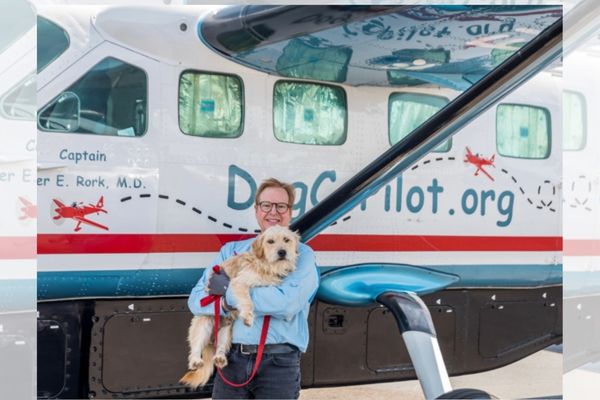
Saving Dogs: We have a seven-figure budget every year, and it takes a lot of $10 donations to get there.
I am going to ask about the National Disaster Search Dog Foundation. What is that exactly, and how do you work with them?
That one is not a big part of it, no. Interestingly, you bring that up because a lot of the other nonprofits that will fly dogs will fly in for the disasters and stuff, and the TV cameras and stuff like that. We’re out doing the heavy lifting every single day. We do not. We’re flying the same routes every day. We really do not have the capacity at this point to absorb those occasional crises that occur with animals. I’ll tell you a quick story that I learned a couple of years ago, that there was a flood down in New Orleans. They had a lot of flood dogs that needed to be flown out.
They reached out to us, and they thought, “This is fine. This is what we’ll do.” I had a couple of days of downtime with that. I flew down to New Orleans, loaded up the aircraft, and flew them back up the Pacific Northwest. Now the problem was that about a week or ten days later, the owners came to the shelters looking for new dogs. Really, the key is to fly the animals out and empty the shelters before the crisis occurs, but who can predict that? It is backward to go in and fly the animals out to her advantage. What they need is increased capacity to house these animals until the owners come looking for them again.
How To Get Involved With Dog Is My Copilot
What are some ways that people who might want to get involved with dogs? How do they reach out to you?
That is the key. They can reach out to our website, DogCoPilot.org. No hyphen. All the other orders. There are four things that people can do if they want to be part of the solution instead of being part of the problem. If you’re not part of the solution, you’re not contributing. Adopt, do not shop. For your next dog, adopt an animal. We have two purebred animals in our household who are both rescues, a golden retriever and a black lab. They are the best.
Honestly, these shelter animals are grateful. You can go and adopt, and better yet, adopt too. They become a bonded pair. They take care of each other when you’re not around, and that works out very well. If you can adopt and foster an animal, get the animal ready to be adopted. Teach it how to socialize with other dogs, how to walk on a leash. How to not jump up on people when you greet them. Now, if you cannot do that, then you can go down to your local shelter, and you can volunteer. Sweep out the kennels, change the water, walk the dogs every day, and change their food dish.
There are things that you can do. Launder their blankets. If you cannot do that, then you can donate. You do not have to donate money. You say, “I am not sure what they’re going to do with the money.” Buy a bag of dog food and drop the dog food off, go to your closet and get those old towels and those old blankets that you do not use, drop them off because they use them in the shelters. We use them on the transports too. You can, instead of donating time, you can donate money.
It is amazing what we can do with $5. It buys almost a gallon of jet aid and we burn 45 gallons an hour. We go through that pretty quickly. It costs almost $800 an hour to run the aircraft. Our typical flight from origin to destination is going to be about 10 hours. That is $8,000. If we have 100 dogs on board, that is $80 a dog. Moreover, suddenly the number drops low. We pay attention to that. Your money will be well spent if you trust us with it.
Coordinating And Collaborating With Animal Shelters
I believe that, and it is a great organization. I have one more question. When you pick the airports that you go into, are they close to the facilities that are getting the dogs? You plan it that way? Did you coordinate it?
Most of those shelters are larger municipal shelters. They usually have an airport nearby, and many times it is a commercial airport. We do not need a large airport to get into. We only need 3000 feet of runway. We do not need 7,000 or 8,000 feet that the airliners use. We can go into virtually any airport. If they are a small rural community, then typically they’ll have 3 or 4 rescue groups that work in that area. Honestly, in Texas, it is so terrible. People down there will just drive along a dirt road, push their dogs out, and drive away. A lot of these dogs are picked up off the streets.

The small communities are peppered with these little mom-and-pop rescue organizations. They’ll get together. We’ll fly in. We’ll have 3 or 4 groups meet us at the staging area, load up the aircraft, and off we go. Since we’re transporting these animals interstate, many times from Texas up to Massachusetts or even Maine now. Nationwide, they need a health certificate. The veterinarians who donate their time to give the animals a health certificate work through, so these are otherwise perfectly healthy and adoptable animals that are going to be euthanized, and it is just a shame.
When we’re loading the aircraft in the morning, these dogs are chirping at each other. They’re in the crates or lined up on the tarmac outside the airplane. I am looking at him, trying to play Tetris in my head. How are we going to load all of these? Once they’re in the aircraft and I close that cargo door and then spin the turbine, that sound these dogs have never heard. They’ve got to be thinking, is it going to hurt? They’ve had such a terrible life until that point. Honestly, our golden retriever, Willow, is just the sweetest dog. It took three months before she could even look us in the eye. Now we cannot keep her off the bed. This is how long it takes for them to get used to it.
Discussion Wrap-up And Closing Words
It is obvious you’re so passionate about what you’re doing, and it just keeps getting better and better. It has been great catching up with you. It really has been.
Thank you so much for the invite. This is great. It was great talking to you a couple of years ago.
Thank you.
Please have me back in a couple of years. Let me tell you how we’ve grown since then.
I am sure you will be.
Next week we’re going to be flying our 48,000 dogs. It is going to be 48,000.
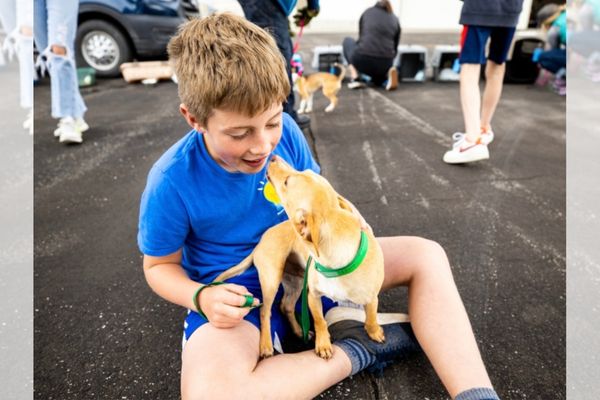
Saving Dogs: We will be flying our 48,000 dogs soon.
That is amazing. That is terrific.
I would love to see them all in one place.
You have to get a big photo op for that one.
Yes, really have them walk by the camera. I have dogs here, so that would be awesome. Thank you so much for having me, and I hope your audiences want to be part of this solution.
How can they not?
They probably already are, because you run a great program. I love listening to it.
Thank you so much. I am going to end by saying that Peter Rork is a Cubs fan. So am I. We’re going to say “Go Cubs.”
We’re having a little tough stretch right now. Anyways, so www.DogCoPilot.org. You can go to, you can see the photos, you can see all the stories. There is a donate button there. I would encourage you to become a squad member where you just $10 a month we charge to your credit card. You will not even notice it. It does not even cost as much as a cup of coffee at Starbucks.
Sounds very good. To my audiences, thanks for tuning in, and remember to stay curious and to stay connected until next time.
Important Links
- Dr. Peter Rork
- Dog Is My CoPilot, Inc.
- Dog Is My CoPilot, Inc. on Facebook
- Dog Is My CoPilot, Inc. on Instagram
- Petco’s Love
About Peter E. Rork, M.D.
 Peter, “The Pilot”, is an East Coast refugee, who always believed that he was switched at birth with a kid from New Jersey. After working his way through medical school as a pilot, he practiced Orthopaedic Surgery for more than thirty years. Instead of retiring to a golf course, he has returned to the skies as our Chief Pilot. Peter holds an Airline Transport Pilot rating and is qualified to fly single and multiengine aircraft as well as seaplanes. He is also a certified flight instructor. Transporting animals to furever homes in a Cessna Turbo Cessna 206 Stationair and Cessna Grand Caravan, he says that the view from his new office beats any other.

0 Comments