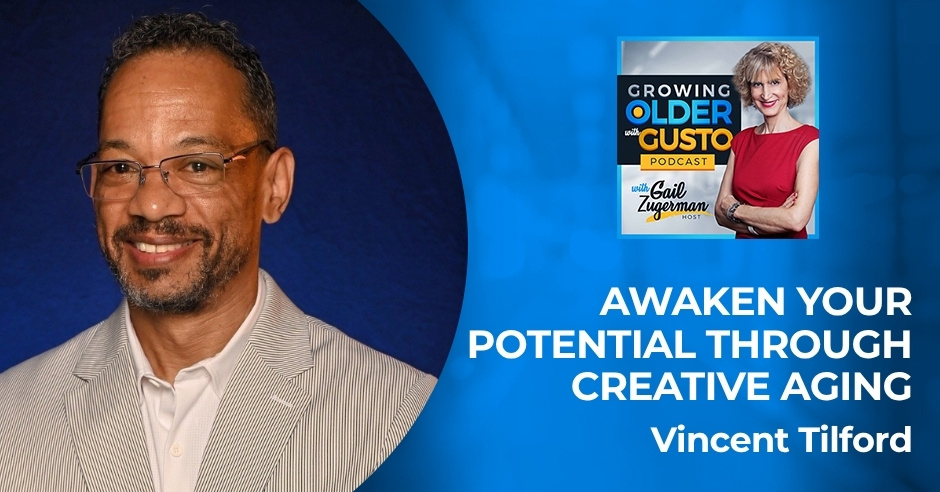
Aging is inevitable, but it does not mean your later years should be miserable and depressing. Vincent Tilford, CEO of The Hannan Center in Detroit, is helping older adults awaken their fullest human potential by teaching them the way of creative aging. He joins Gail Zugerman to share how he is looking to support and renovate care for the elderly through their programs focused on art, lifelong learning, and self-development. Vincent also talks about how American psychiatrist Dr. Gene Cohen inspired his career and how they are battling government cutbacks at The Hannan Center.
—
Watch the episode here
Listen to the podcast here
Awaken Your Potential Through Creative Aging With Vincent Tilford
Welcome to Growing Older with Gusto. I am your host, Gail Zugerman. This is a show that is dedicated to the art of growing older in a positive and productive way. We have on the show as our guest, Vincent Tilford, who is the president and CEO of the Hannan Center, a Detroit, Michigan not for profit dedicated to enhancing the quality of life for people getting older.
Mr. Tilford has been involved with the older community for 30-plus years and supports the expansion and renovation of care in the facility in Detroit. His background includes executive roles with Habitat for Humanity, Detroit, among others. He is a champion for aging equity. He has a lot to tell us about the Hannan Center and how he is helping people grow older with gusto. Welcome to the show. What should I call you?
You can call me Vince. That’s fine.
Okay, great. Vince.
Thanks for having me, Gail.
Defining And Understanding The Concept Of Creative Aging
Awakening Human Potential In The Second Part Of Life
Sure. Tell us a little bit about what you refer to as “creative aging.” What is that exactly?
You could think of creative aging as this movement that basically says that our capacity to create and learn does not diminish over time. It actually deepens because when you think about creative pursuits, it doesn’t necessarily have to rely on memory, although certainly memory helps. When you give people this robust training around the arts, when I talk about arts, it could be music, it could be language, it could be storytelling, or acting. When you get a lot of robust activity around that, it helps to produce these wonderful health outcomes for older adults.
Here at Hannan, we’ve embraced that concept. I started at Hannan several years ago. I didn’t know anything about creative aging at the time, and then I started exploring it some more. I was impressed with these outcomes that were proven in a longitudinal study that was done many years ago. It showed that older people not only have a deepening understanding of themselves, but they are also more creative. The other issue with older people is that when you bring them together, you reduce isolation. You begin to see some wonderful health outcomes, like fewer doctor’s visits, fewer medications, and that kind of thing.
When you bring older people together, we reduce isolation and begin to see some wonderful outcomes.
My husband is a retired physician. He used to always joke about how the older people used to come in an hour so early because this was their mission, to your point.
Absolutely. Any time we do events for people over the age of 60, almost half of the crowd shows up early.
How Dr. Gene Cohen Inspired Vincent
Who is Dr. Gene Cohen? How did he impact you personally?
I didn’t know much about creative aging before I started this job several years ago. Dr. Gene Cohen is probably the first person to have coined the term creative aging. He did a longitudinal study where he provided robust arts training to older people over a period of years, and then he began looking at what their health outcomes were like. When he did this, that’s when he found that they were reporting that they didn’t go to the doctors often. They were not taking as many pills as they used to.
There’s other research that shows people who have been in creative pursuits for many years. I want to caveat this. You can do it later in life as well, but the research shows that when people have done this for a lot of years, they build up this cognitive reserve. It shows that people who are doing creative things in music and language, on average, if they’re going to get dementia, it’s usually four to five years later than when other people who don’t have that cognitive reserve would normally get it.
That’s how I got started in this. I started reading his research and everything. We began doing some things here at Hannan to jump in and embrace creative aging. We used to call it our lifelong learning classes, but now we call it Beyond U. These classes have a progression. You can Beginning Art, Intermediate Art, and Advanced Art. We have Performing Arts, and we always hire professional artists to teach them. We don’t want this to feel like a craft or like it’s a hobby. This is where people come to our classes, and they come to them with the purpose and intention. That’s also a part of creative aging as well. It gives you a purpose.
How The Hannan Center Programs Promote Long Life
Let me ask you this. The Hannan Center, which I’m not that familiar with, is basically where people don’t live in it. People are coming to take courses that will promote a good, long life.
That’s partly. Yes. I probably should have led with that, Gail. We turned 100 years old in 2025. When we first started out, it was started by Luella Hannan. What she cared about most was that older people get to live their lives out with dignity and with purpose. That was her idea. Initially, she wanted to build a senior apartment building where everybody could have all the services and resources that they needed in this building. They didn’t have to worry about anything.
That didn’t happen for a long time for a variety of reasons. For the first 50 years of our history or so, we basically gave people a lifetime stipend to age in place in their homes. After 50 years, we then built a facility that housed seniors for about twenty years. The facility that we built became obsolete as senior housing became more involved. Other housing with other services was built around us. We shifted again to helping seniors find purpose in terms of aging in place, and trying to bring services to them and bring them out to the Hannan buildings as well.
We’re located in Detroit, Michigan. We are actually located in the cultural districts. There are multiple galleries and museums around us. We had a tiny gallery when I first started. We expanded the gallery, and we now promote older adult art. We have older adult exhibits that have older adult themes. We do an annual art competition. As I mentioned before, the Beyond U classes feed into that as well. People come here for the art, for the connection, and a place to learn.
We also help people on the social work side of things. When I talked about Hannan, if you’re familiar with Maslow’s hierarchy of needs, we try to meet people wherever they may be on that hierarchy. If they’re struggling with the basics, like housing, shelter, and that kind of thing, we become that community resource navigator and help them get housing or access to housing. We provide connections as you go up the hierarchy. That feeling of belonging is important. At the very top is what you call self-actualization. That’s where our creative aging classes come into play because people are allowed to do things and explore things. I’m amazed at the talent and creativity that we see among our students here.
Reflecting On The Impact Of Dr. Cohen’s Book
Getting back to Dr. Cohen’s book, The Creative Age: Awakening Human Potential in the Second Part of Life, does that still influence people today?
I don’t know that they know Dr. Cohen, especially, but I would say that the people with whom we work understand what the concept is, and they do embrace it. We saw this in particular during the pandemic. During the pandemic, people weren’t coming to our building, so we had to shift to virtual. It was amazing how resilient and adaptive our students were. We were teaching art virtually, and the classes grew. As the classes grew, you saw these different connections occurring.
The first part of class will be people catching up. “What’s going on in your life right now?” That connection is really important. We then have them riffing off of each other, commenting on each other’s work. Art classes are both instructive, but they’re also an opportunity to workshop pieces that people have been working on as well. They get it, they understand it, and those who participate in our classes are some of our biggest supporters around that. I still think it’s empathy creative aging. Even though Dr. Gene Cohen wrote this paper many years ago, it is embraced in other parts of the country. We’re here in Michigan. We’re probably one of maybe two or three organizations in the entire state that have a full creative aging program.
How many people are at your center at a particular given time?
It could vary. Usually, it’s like a flow throughout the day. We probably have a couple of hundred people who flow in throughout the day for various reasons. They could be coming to our classes. They could be coming for case management. They could be coming for counseling. We have an adult day program for people who have a dementia diagnosis. We serve not only the people with the diagnosis but the caregivers as well, and provide services to them. It depends. We do have quite a bit going on here.
The Right Time To Apply Creative Aging To Your Life
How can people apply creative aging to their lives? At what age do you think this is important to start thinking about?
As I alluded to earlier, the earlier we begin to embrace creative aging, the better off you’re going to be. You’re going to build or strengthen that cognitive reserve sooner, but you can still do it later in life as well. They looked at people who were polyglots, or spoke more than one language. If they’ve done that all their lives, you find that they have a much stronger, or more of a cognitive reserve, than those of us who have not done that.
When I first started reading about this, one of the things I’ll tell people is we should never be ashamed of saying our age. We always other people who are older. I used to do this quite a bit. Now I tell people that I’m 64, and I’m getting bombarded with Medicare offerings right now. One of the things that I started a few years ago, as I hadn’t taken French in high school, was that I started taking French again and looking at French movies.
One of the things that this does is that it causes you to have to switch back and forth in your head between languages. It makes your mind a little bit more nimble. Same thing with music. I was in a choir. Sometimes I go and play the piano. It stretches your mind. It involves you emotionally. It’s creating those new neural pathways. It connects both sides of the brain, not just the left side.
When we think about problem-solving, the logical or executive functions, it begin to connect both sides of the brain. I would say get involved, even if it is music appreciation. That is also helpful. If you yourself are practicing music, language, or any art, it does help to create those new pathways. It helps us to build up some protection against dementia.
If you are practicing music, language, or any form of art, it creates new pathways in the mind and builds up protection against dementia.
How The Hannah Center Deals With Ageism
Let’s get back to the Hannan Center again. What are you doing there now? What are some of the challenges you’re facing?
Someone asked me a question when I first started in this job. The question that they asked me was how I would know if I was successful in my job. I have been on the job for probably about a year. I had watched how even the people who came to our programs struggled with the idea of getting older. It’s our own preconceived notions about old age.
They call it ageism.
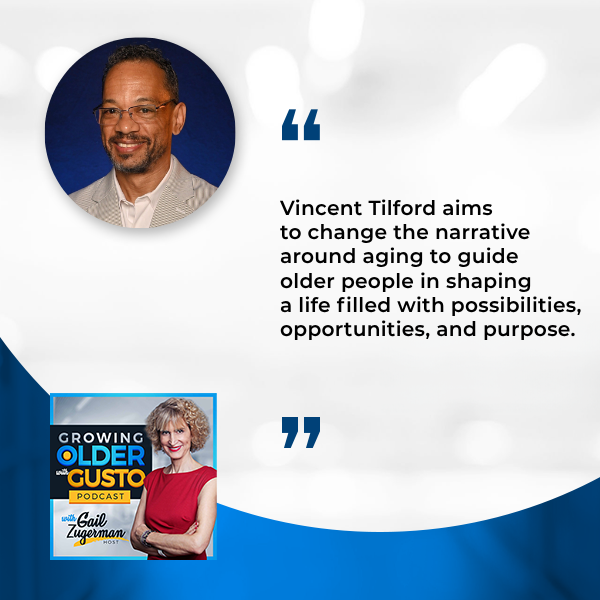
Exactly, ageism. That was my answer to them. If we can begin to change the narrative around aging so that it is still filled with possibilities and opportunities that we can contribute to our society as we age, then I count myself successful. One of the things that I want to do here at Hannan is build on some of our existing programs where we are showcasing older adults contributing, who are making a difference, whether it’s in their family or even in a larger setting.
One of our programs that we do is what we call 70 Over Seventy. If you live in a big city, you’ve heard of Crain’s 40 Under 40, where they recognize young, upcoming professionals. We do it for 70 people over 70 in about seven different categories. I remember one year, this gentleman was our top winner, and I forgot the category that he was in. He was in a wheelchair and he could barely feed himself, but he spent the last 50 years of his life at that time, researching a legal case that ended up exonerating someone who had been put away in prison for life. I had to go and roll him up on stage in his wheelchair.
I thought what a great shining example of we have so much to give, and if we listen to people say, “Just sit in the corner, go associate with the older people,” and that kind of thing, not only are we lessened or diminished by that, but society is diminished as well. They are deprived of the talents and skills that people have.
One of the reasons I started the podcast was that it became apparent to me, in working and being on boards, that a lot of older people get thrown under the bus. Why? Because of the ageism in our country. I feel that older people have so much wisdom to dispense. I wanted to give them a forum to speak out and talk to people about how they got to where they are. How did they get to be 90 to 100 and still be going strong?
It was interesting because one of my recent podcast episodes was with a man who was 102. He said, “I still feel needed. My family still needs me.” I think that’s so important. The fact that he felt that way was a wild moment for me.
I love that, Gail. Are you familiar with the Blue Zones?
Yeah, of course.
When I go out and I talk about Hannan, I always talk about the Blue Zones. When you look across all the Blue Zones around the world, two things are common among them, which are probably the two strongest predictors. One is that they’re part of a community. That community counts on them for their wisdom, for their advice, for their oral history, or whatever it might be. It’s valued. That leads to the second thing, and that is having a purpose. When we have community and when we have purpose, it is a strong predictor of being able to age well. We are able to add life to years, as opposed to years to life.
What’s In Store For The Hannan Center In The Next Several Years
That’s great. I like that. What do you see in the future for the Hannan Center?
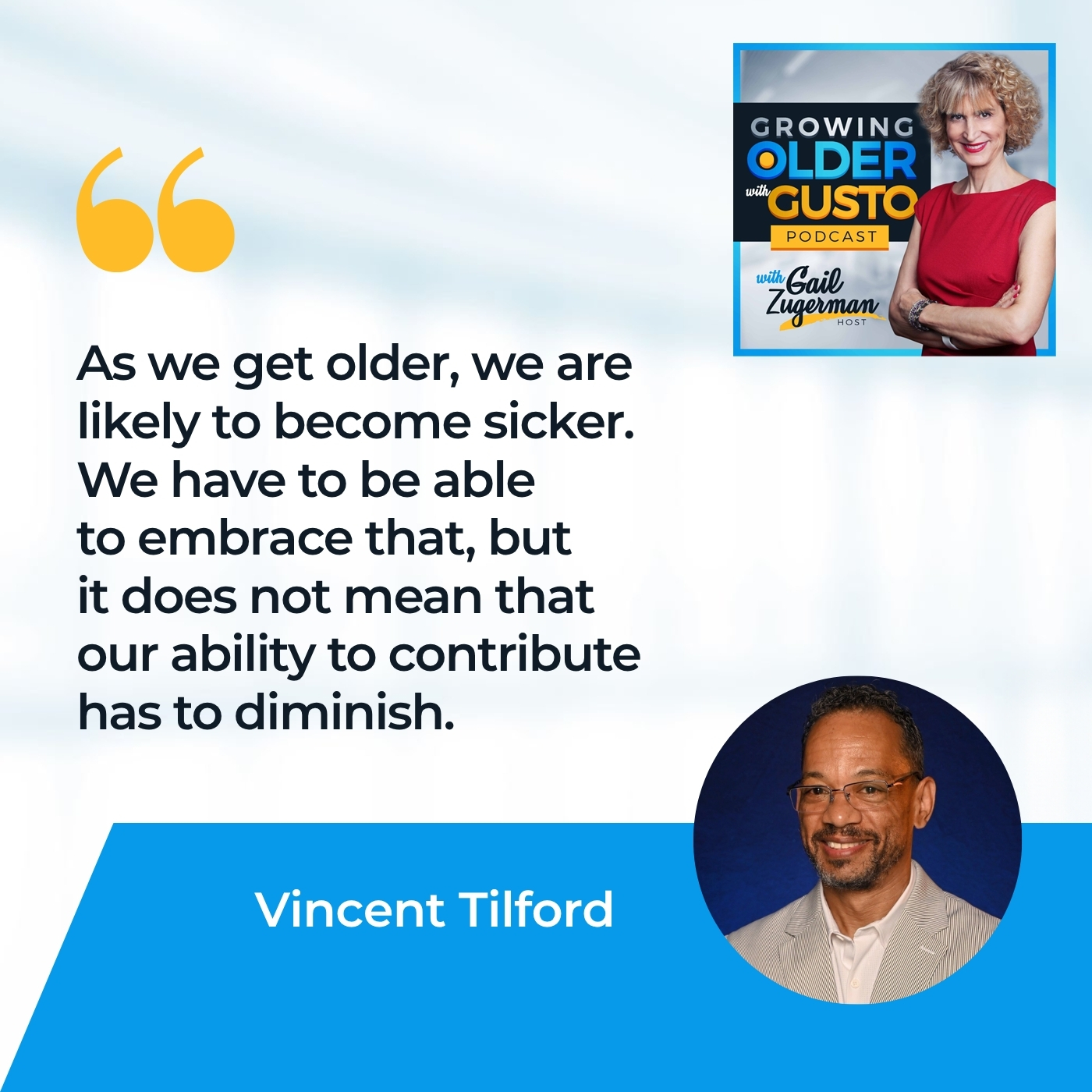
As I started talking about earlier, it’s important for us to show aging in all of its facets. It is true that as we get older, we’re likely to become sicker. It doesn’t have to happen, but it could be. That’s okay, and we have to be able to embrace that, but it doesn’t mean that somehow our ability to contribute diminishes. We try to show this through our 70 Over Seventy program, where we get people nominated. We showcase them, and people are always amazed at the people who are doing things today, where most people would say, “You need to go sit down and go into the corner somewhere.” That’s one of the things I want to expand here.
The other thing that I want to expand on is what we call our Emerge Art Festival. This was actually an idea from one of our trustees. It’s an idea to promote those artists over age 55. Cohen talked about the latter stages in life. There are these four stages. The first part of it is where you’re exploring, trying to figure out what you’re going to do. You then get to this point where you don’t care anymore, and you feel liberated. Now you can do the things that you want to do.
That’s where I see a lot of our emerging artists because they’ve shifted careers. A lot of them may have just started out. Now, they are creating art. Not only are they creating art, but they’re also selling their art. They’re having exhibits around the city. They didn’t realize they had these talents before they started going through these programs. Those are the two main things I would say.
The other thing I would mention, too, is I see creative aging as one intervention in terms of how we would stave off dementia. We also have an older adult day program for people who have a dementia diagnosis. We try to bring art into that to try to build up that cognitive reserve. I would love to expand that program because we’re the only one in the city of Detroit that has a specialty in working with people with a dementia diagnosis, and the caregivers who are burnt out and often don’t know how to address the behaviors. They’re trying to get people to meet them where they are, versus them meeting their loved ones where they are.
Creative aging is one effective intervention in staving off dementia.
Navigating The Impact Of Federal Policies And Budget Cuts
We’re all aware of the cutbacks in our country from the government, whether it’s for medical research or otherwise. What is the impact of Federal policies and budget cuts on the older adult population in your estimation?
That’s a great question, Gail. As I told you, we started 100 years ago. When we started, we were the social safety net. When you think about the social safety net, you think about Social Security. We were ten years before Social Security. When you think about Medicare and Medicaid, we were 40 years ago before Medicare and Medicaid. That’s what we were doing with the seniors that came to our doors back in the mid to late ‘20s and early 1930s. That’s what we were doing. We were helping them take care of basic necessities, making certain that they got medical treatment, that they had a place to stay, and then we also gave them a lifetime stipend.
When I go out and I talk about this, particularly, since the summer, when we had the big beautiful bill hit, I had been concerned about that a lot. For a lot of the seniors, it’s hard to be self-actualized when you worry about, “Where am I going to sleep tonight?” We have seniors who received subsidies and live in subsidized apartment buildings. As they’ve been cutting, there’s a real concern now. They haven’t cut that yet, but the seniors that I spoke to are very concerned about what’s going to happen here.
Medicaid is another one. People want to try to make it seem like Medicaid is funding immigrants and that thing. Here in Michigan, 40% of all births are funded through Medicaid. It’s a quarter of our population in Michigan. It’s about 1.5 million to maybe 2 million people on Medicaid, and these aren’t all older people. These people have disabilities, our children. There are rural areas supporting rural hospitals. I’m worried about what’s going to happen in a lot of these communities.
Here in Michigan, we do this a lot. We hold up our hands. This is Michigan. It’s Michigan shaped like a mitt. When you look at all of these counties that are up here in the upper part of this mitt, those are all pretty much rural counties, and they’ve seen an exodus of younger people as they go to look for jobs and they move to other places. That leaves older people there. These older people are struggling. The organizations up there are struggling to provide resources to those older people to make certain that they’re basic needs are being cared for.
This is irrespective of how much they’ve saved in life. Certainly, we have super-wealthy people, but these are people who have worked hard all their lives. The fact is that it’s still tough for them to survive in this economy. I’m afraid that that’s going to worsen as well. Here’s what we’re going to do with Hannan to try to address that. The stated goal of reducing Medicaid was to reduce fraud and abuse. That was the stated goal.
Let’s take that at face value. How are you going to do that? They’re going to require people to now prove their eligibility twice a year. There’s going to be greater reporting requirements. They’re creating an administrative burden, and you think about it. Let’s say that I’m 80 years old. I have to go in and recertify. If you make me go in person, I’ve got to find somebody to get me there, potentially, if I’m not driving.
Another example. You create a burden, and then when people can’t meet that burden, it’s not because they don’t qualify but because of their circumstances, their financial, their health, or whatever the case may be. They’re not able to finish their application. What we’re trying to do is alleviate that administrative burden. If they want us to, we will help them with those applications.
We will try to find them transportation to where they need to go to prove their eligibility. We are here to be a resource for them. Typical resources, you used to be able to call. It’s in the Federal government. There are resources there, but those have been cut too. Our role is what we did at the very beginning: Help people to age with dignity by helping them to access those resources as best we can.
Get In Touch With Vincent And The Hannan Center
Thank you very much. This has been very interesting, learning about what you’ve been doing with the Hannan Center. I’m wishing you all the best. If our audience would like to get in touch with you to learn more, maybe they’re in Detroit and wanted to reach out to you, what’s the best way to do that?
They can visit our website at Hannan.org. They can also follow us on Facebook and Instagram. Our Instagram is @HannanCenter. On there, I provide a lot of little reels around Medicare and Medicaid. I do a thing called Medicare Medicaid Monday, so that people can know what’s going on out there. That’s another way. If you’re in the Detroit area, call us at 313-833-1300.
Great. To our audience, thank you for tuning in. If you enjoyed this episode, please leave a review for us on iHeart or Apple. Vince, it was great speaking with you, learning all about what you’re up to, and how you’re helping people age in a positive and productive way.
Thanks, Gail. I love what you’re doing as well.
Thank you.

0 Comments